For centuries, reading in a foreign language meant one thing: pausing to look up every unfamiliar word in a dictionary. You would lose your place, break your reading flow, and often forget what you were reading about by the time you found the definition.
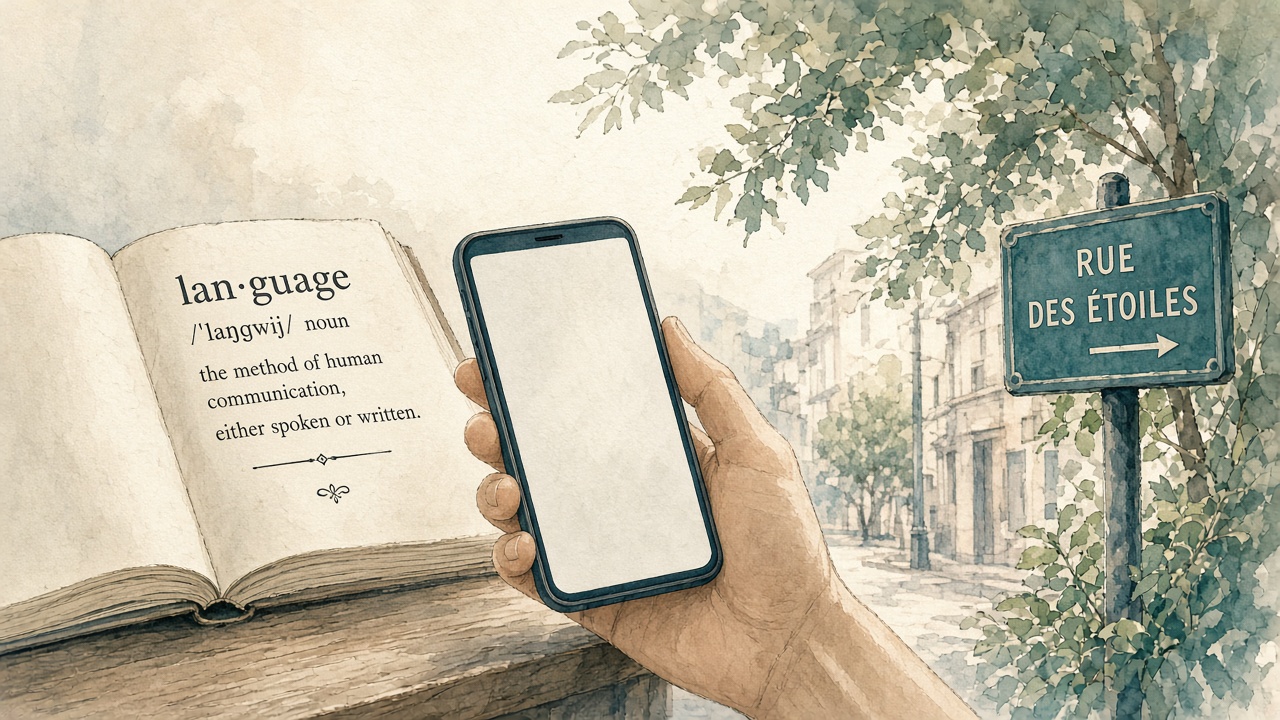
Camera-based dictionary apps have fundamentally changed this experience. By pointing your phone at any text — a book page, a restaurant menu, a street sign, a product label — you can instantly see definitions and translations without interrupting your reading flow.
The Old Way vs. The New Way
Traditional dictionary lookup follows a predictable but painful pattern:
- Encounter an unfamiliar word
- Open a dictionary app or website
- Type the word (hoping you spell it correctly)
- Scroll through results to find the right definition
- Return to what you were reading
- Try to remember the context
This process takes 30 seconds to a minute per word. For a learner encountering 10-20 unfamiliar words per page, that adds up to an exhausting amount of friction.
Camera-based lookup compresses this into a single gesture: just point. The word is recognized, defined, and translated in under a second. You never leave the page, and the context stays fresh in your mind.
Why Context Changes Everything
The real breakthrough of camera dictionaries is not speed — it is context. When you look up a word while staring at the sentence it appears in, your brain creates a much richer memory association than looking it up in isolation.
Research in cognitive psychology calls this "contextual encoding." You are not just learning what a word means — you are learning how it is used, what words surround it, and what situation you were in when you encountered it. All of these contextual cues make the word easier to recall later.
Real-World Use Cases
Camera dictionaries are not just for students in a classroom. They are useful in everyday scenarios that most people encounter regularly:
Traveling Abroad
Navigating a foreign city becomes dramatically easier when you can instantly read signs, menus, and transit schedules. Instead of relying on pre-translated guides or awkwardly pointing at things, you can independently understand the world around you.
Reading Foreign Literature
Many readers want to explore literature in its original language but give up because the constant dictionary lookups destroy the reading experience. Camera-based apps restore the flow, making it realistic to read books that would otherwise be inaccessible.
Professional Contexts
Business travelers, researchers, and professionals who work with multilingual documents benefit enormously from instant lookup. Whether it is a contract in another language or a research paper with technical terms, having a camera dictionary at hand saves significant time.
Learning Through Daily Life
Language learners who live in or visit a country where their target language is spoken can turn every walk, every grocery trip, and every restaurant visit into a learning opportunity. Every piece of text in the environment becomes a potential vocabulary lesson.
What Makes a Great Camera Dictionary
Not all camera dictionary apps are created equal. The best ones share a few key characteristics:
- Speed: Definitions should appear in milliseconds, not seconds. Any delay breaks the reading flow.
- Accuracy: Text recognition needs to work reliably across fonts, lighting conditions, and surface types.
- Depth: A quick translation is helpful, but a great app also provides pronunciation, etymology, usage examples, and related words.
- Language breadth: The more languages supported, the more useful the tool becomes across different contexts.
- Offline capability: Internet is not always available, especially while traveling. The best apps work even without connectivity.
The Future of Reading in Foreign Languages
Camera-based dictionaries represent a shift from "translate everything" to "understand as you go." Rather than relying on full-page translations that strip away the original language, learners can engage with authentic text while getting help exactly where and when they need it.
This approach builds genuine reading skills over time. As you look up fewer and fewer words per page, you can tangibly feel your proficiency growing. The camera dictionary gradually makes itself unnecessary — which is exactly the point.
The gap between "I cannot read this" and "I can figure this out" has never been smaller. Camera dictionary apps are putting the power of instant understanding in everyone's pocket, making foreign text feel a little less foreign every day.